
Artificial Intelligence and Water: The Invisible Challenge of the 21st Century
Artificial intelligence relies on water-intensive infrastructure. Discover the hidden impact of AI on water resources, economy and sustainability.
The digital economy runs on water
The digital economy runs on data.
But behind the data, there is water.
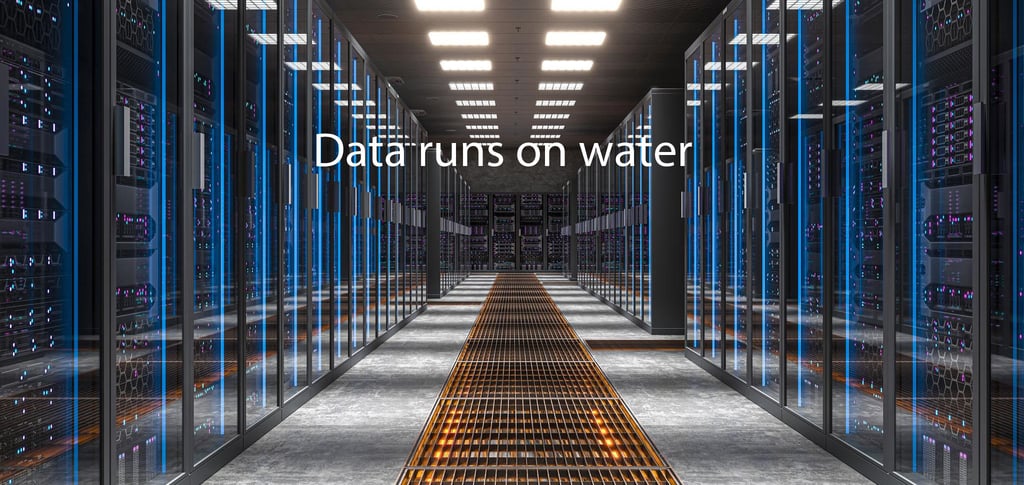
Every online search, every AI query, every streamed video depends on a vast physical infrastructure that remains largely invisible to users: data centers.
These facilities are often perceived as purely digital environments. In reality, they are highly resource-intensive industrial systems.
And one of their most critical resources is water.
The expansion of data centers
In recent years, the growth of data centers has accelerated at an unprecedented pace.
The rise of artificial intelligence, cloud computing, and digital services has created an exponential increase in data processing demand.
Major technology companies are investing billions in new facilities across the world.
From the United States to Europe and Asia, new data centers are being built to sustain the expanding digital ecosystem.
This growth reflects a fundamental shift: the digital economy is no longer virtual.
It is physical.
And it requires infrastructure, energy, and water.
Water consumption at scale
One of the least discussed aspects of data centers is their dependence on water.
Servers generate heat when processing data.
To maintain optimal performance, this heat must be dissipated.
Water-based cooling systems are among the most efficient solutions available.
They allow data centers to operate continuously and reliably.
However, this efficiency comes at a cost.
Large-scale data centers can consume millions of liters of water every year.
In some regions, a single facility can use as much water as a small town.
This consumption is not always visible, but its impact can be significant.
Local impact in water-stressed regions
The location of data centers is not random.
They are often built in areas with access to infrastructure, energy, and connectivity.
But increasingly, they are also being developed in regions already experiencing water stress.
This creates a potential conflict.
When large volumes of water are allocated to industrial cooling systems, local communities may face increased pressure on their own water supply.
Agriculture, households, and ecosystems may compete with technological infrastructure for access to the same resource.
This raises important questions about priorities and sustainability.
Technology companies under pressure
As awareness grows, major technology companies are facing increasing scrutiny regarding their water usage.
Some have begun to publish data on their water consumption and to commit to reducing their environmental impact.
Initiatives include:
improving cooling efficiency
using recycled or non-potable water
investing in water restoration projects
developing alternative cooling technologies
However, the scale of digital growth presents a challenge.
Efficiency improvements may not be enough to offset the rising demand driven by AI and global digitalization.
The emergence of a new resource conflict
The expansion of data centers highlights a broader issue:
the intersection between technological growth and natural resource limits.
Traditionally, conflicts over resources have focused on energy, minerals, or land.
Today, water is becoming part of that equation.
This is not a visible conflict.
There are no headlines about data center wars.
But the pressure is real.
And it is growing.
Water, once considered abundant in many regions, is now increasingly recognized as a strategic resource.
Rethinking infrastructure in the digital age
The challenge is not to stop technological progress.
It is to align it with resource sustainability.
This requires a new approach to infrastructure planning.
Future data centers will need to integrate:
water-efficient cooling systems
location strategies based on water availability
circular water use models
transparency in resource consumption
The digital economy cannot be built independently of the physical world.
It depends on it.
Two systems, one reality
Artificial intelligence represents the future of knowledge and innovation.
Water represents the foundation of life and physical systems.
These two dimensions are now deeply interconnected.
The more digital the world becomes, the more it relies on physical resources.
This creates a paradox:
The more advanced our technology, the more dependent we are on basic natural systems.
Conclusion
Data centers are not just technological facilities.
They are part of a broader system that connects digital progress with natural resources.
Understanding this connection is essential.
Because the future of the digital economy will not be defined only by computing power.
It will also be defined by how efficiently we manage the resources that sustain it.
Final reflection
The image does not only represent technology.
It represents a deeper relationship.
The connection between intelligence, infrastructure, and the most essential resource on the planet: water.
In a world under increasing pressure, innovation alone is not enough.
It must be supported by responsible resource management.
Final statement
The digital economy is built on data.
But its true foundation is water.
Pere Castells Teulats
Researcher and Science Communicator