
Artificial Intelligence and Water: The Invisible Cost of Digital Progress
Artificial intelligence depends on massive data centers that consume large amounts of water. Discover the hidden water footprint behind digital progress and AI expansion.
How data centers and AI systems are increasing global water demand
Visible progress, invisible cost
Artificial intelligence is transforming the world at an unprecedented pace.
From virtual assistants to advanced systems capable of processing massive amounts of data, AI has become a key driver of innovation.
Yet behind this progress lies a factor rarely discussed:
Water.
The hidden infrastructure of AI
Every interaction with AI systems activates a global network of data centers.
These facilities are the physical backbone of the digital world.
Inside them, thousands of servers operate continuously.
And they generate heat.
Cooling systems and water dependency
To keep these systems running, that heat must be managed.
One of the most effective solutions is water-based cooling.
Water absorbs heat and stabilizes system performance.
However, this comes at a cost.
Large data centers can consume millions of liters of water annually.
The growing water footprint of AI
As AI evolves, so does its infrastructure.
More users, more applications, more complex models.
This results in:
higher computational demand
more servers
more data centers
increased energy and water use
Digital expansion has a material footprint.
Technology meets water
Water has traditionally been associated with agriculture, industry, and human consumption.
Now, technology joins the equation.
Digital systems depend on physical resources.
And water is becoming one of the most critical.
A strategic resource challenge
This raises an essential question:
Can technological growth continue without considering its water impact?
In water-stressed regions, data centers can intensify pressure on local resources.
Planning must evolve.
The invisibility problem
This consumption remains largely unseen.
Unlike other sectors, the public rarely perceives it.
Yet it is growing steadily.
And its cumulative impact matters.
Toward sustainable innovation
The goal is not to slow innovation.
It is to make it sustainable.
This requires:
improving cooling efficiency
recycling water
reducing dependency
integrating water into planning
Two eras converge
Artificial intelligence defines the digital future.
Water defines the physical foundation.
Their intersection creates a new reality.
Conclusion
AI is not intangible.
It depends on real resources.
Understanding this is essential.
Because future progress will depend not only on innovation,
but on resource management.
Final reflection
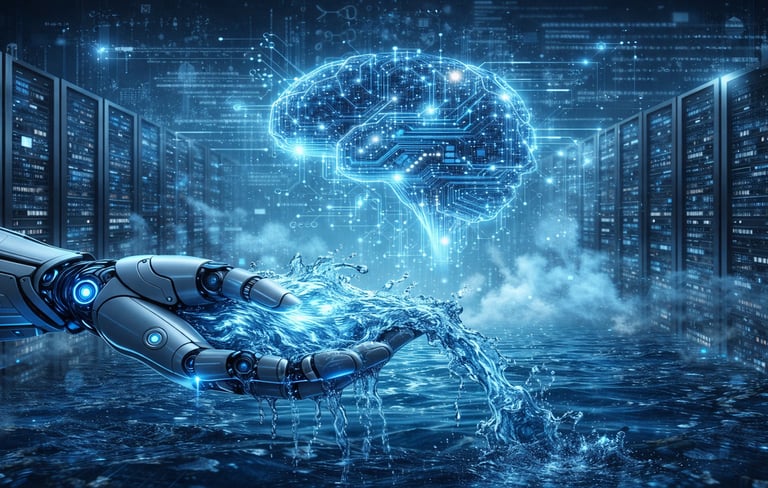
The image does not only represent technology.
It represents an idea.
The relationship between intelligence, innovation, and the planet’s most essential resource: water.
In a world under increasing pressure, understanding and managing water will be as important as any technological advancement.
Final statement
The digital future will not only be measured in data.
It will also be measured in water.
Pere Castells Teulats
Researcher and Science Communicator