
China, Water and the Future of Geopolitical Power
China is turning water into a strategic geopolitical resource through mega dams, river control, hydraulic infrastructure and long-term water security planning linked to energy, technology and economic stability.
China, Water and the Future of Geopolitical Power
Water Security and the Emerging Global Balance
For decades, global geopolitical influence was largely shaped by oil, industrial power and military capacity.
However, the 21st century is progressively introducing another strategic factor capable of redefining the global balance of power: water.
Among the world’s major powers, China is emerging as one of the countries most actively integrating water management into its long-term economic, technological and geopolitical strategy.
Water security is becoming increasingly linked to national security.
And China appears to understand this transformation earlier than many other nations.
China’s Structural Water Challenge
China faces one of the most complex water management challenges on Earth.
The country is home to nearly 20% of the global population, yet it possesses considerably less freshwater per capita than many other major economies.
This imbalance creates enormous structural pressure on:
agriculture
industrial production
urban growth
energy generation
food security
technological expansion
At the same time, China continues to urbanize and industrialize at extraordinary speed.
This combination has transformed water stability into a strategic national priority.
Unequal Water Distribution
One of China’s biggest internal challenges is the uneven geographical distribution of freshwater resources.
Most of the country’s major water reserves are concentrated in the south, while large northern regions face chronic water scarcity.
Northern China contains some of the country’s most important:
industrial corridors
agricultural areas
technological centers
population hubs
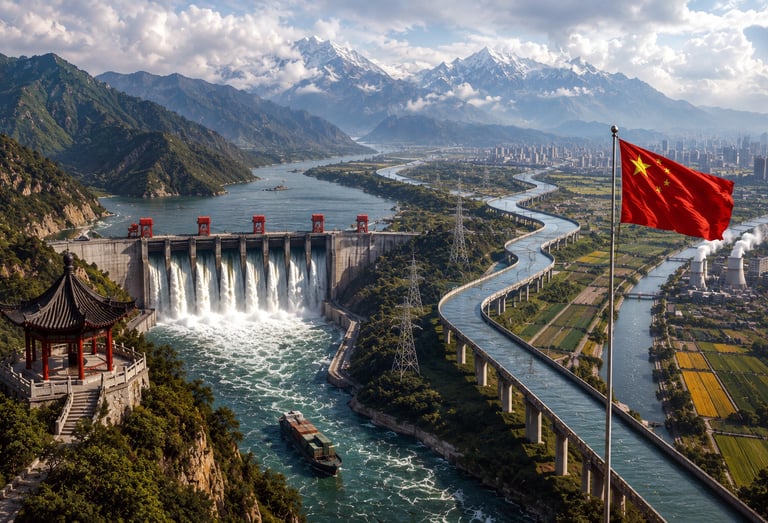
This imbalance has forced China to develop some of the largest hydraulic infrastructure projects in modern history.
Mega Dams and Hydraulic Infrastructure
China has invested heavily in massive dams, reservoirs and river management systems.
These infrastructures serve multiple long-term objectives:
hydroelectric generation
flood control
agricultural irrigation
industrial supply
water transfer
resource security
The most internationally recognized example is the Three Gorges Dam, one of the largest hydroelectric projects ever constructed.
However, China’s hydraulic strategy extends far beyond a single megaproject.
The country continues developing extensive infrastructure capable of reshaping entire river systems.
Water is increasingly treated not simply as a natural resource, but as strategic infrastructure.
The South–North Water Transfer Project
One of the most ambitious hydraulic engineering projects ever attempted is China’s South–North Water Transfer Project.
Its objective is to redirect enormous quantities of freshwater from southern river systems toward the increasingly water-stressed northern regions.
The scale of this megaproject reflects how seriously China considers long-term water security.
It also demonstrates a growing global reality:
The countries capable of guaranteeing stable access to water may obtain decisive economic and geopolitical advantages in the future.
Water, Energy and Technological Expansion
China’s economic growth depends heavily on stable water access.
Water is essential for:
manufacturing
electricity production
agriculture
semiconductor industries
cooling systems
urban infrastructure
industrial expansion
As artificial intelligence, cloud computing and large-scale digital infrastructure continue expanding, the relationship between water and economic stability becomes even more critical.
The digital economy depends on physical infrastructure.
And much of that infrastructure depends on water.
This increasingly connects water not only to environmental sustainability, but also to technological competitiveness and economic resilience.
The Himalayan Water Towers
One of the most geopolitically sensitive aspects of China’s water strategy involves the Himalayan region.
The Himalayas contain some of the world’s largest freshwater reserves outside the polar regions.
Several major Asian rivers originate in these mountain systems and supply water to hundreds of millions of people across the continent.
These river systems influence regions linked to:
India
Bangladesh
Southeast Asia
Tibet
western China
For this reason, the Himalayas are often described as Asia’s “water towers.”
Infrastructure development and river management policies in these areas carry growing geopolitical implications.
Cross-Border Water Tensions
Several Asian countries have expressed concerns regarding upstream dam construction and long-term river management policies.
The strategic control of freshwater sources may increasingly influence regional diplomacy, economic negotiations and geopolitical stability.
As climate change intensifies hydrological uncertainty, water access could become one of the defining strategic issues of the century.
Future geopolitical tensions may increasingly revolve around water security in the same way previous decades were shaped by energy security.
Climate Change and Hydrological Stress
China also faces significant climate-related water risks.
Among the most important challenges are:
prolonged droughts
glacier retreat
irregular rainfall
desertification
flooding
agricultural pressure
The melting of Himalayan glaciers could significantly alter river flows across Asia during the coming decades.
This creates long-term uncertainty for populations, agriculture and industrial systems that depend on these water resources.
Water, Agriculture and Food Security
Beyond industry and energy, water also plays a decisive role in China’s food security strategy.
China must feed one of the world’s largest populations while managing limited freshwater resources and increasing environmental pressure.
Agriculture remains one of the country’s largest water consumers, particularly in northern regions already affected by water stress.
This creates a difficult balance between:
food production
industrial growth
urban expansion
environmental sustainability
For this reason, China continues investing in irrigation systems, reservoirs and agricultural modernization technologies designed to improve water efficiency.
Securing agricultural stability is considered essential for maintaining long-term social and economic resilience.
Water and the Future of Global Power
China’s approach demonstrates that water is no longer viewed merely as a natural resource.
It is increasingly considered:
strategic infrastructure
economic security
technological support
geopolitical leverage
national resilience
The countries capable of securing long-term water stability may hold decisive economic and geopolitical advantages in the emerging Water Era.
Conclusion
China’s hydraulic strategy reflects a profound global transformation already underway.
The future balance of power may depend not only on energy, military capacity or technology, but also on the ability to guarantee stable access to freshwater resources.
From mega dams to Himalayan river systems, China is positioning water at the center of long-term national planning.
The 21st century may increasingly be shaped by water geopolitics.
And the nations that understand this transformation first may gain strategic advantages in the emerging global Water Era.
Pere Castells Teulats
Researcher · Science Communicator