
Can Marine Sediments Naturally Preserve Freshwater? | Marine Aquifers & Water Security
Discover how marine sedimentary formations may preserve freshwater beneath the seabed. Explore marine aquifers, hydrogeology and a new research perspective on future water security in the Water Era.
Can Marine Sediments Naturally Preserve Freshwater?
A New Research Perspective for the Water Era
Freshwater is becoming one of the world's most strategic resources.
As droughts intensify, populations grow and climate change places increasing pressure on conventional water supplies, scientists are increasingly exploring hidden freshwater resources beneath coastal regions.
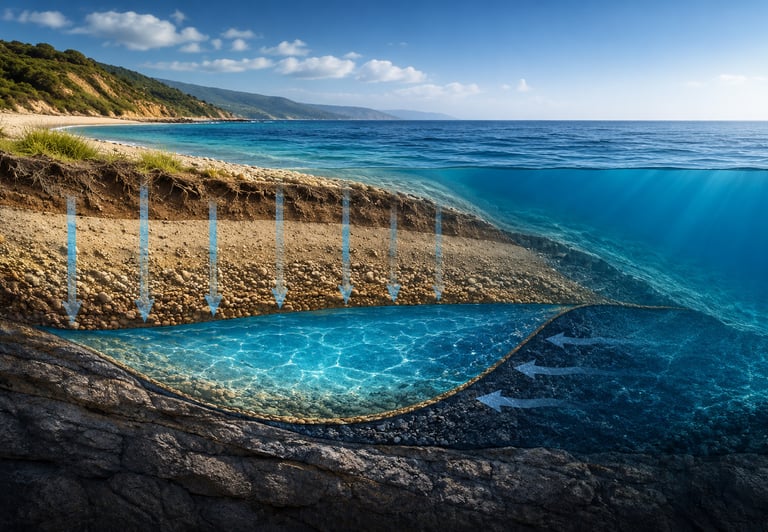
Among the least known of these are marine aquifers—freshwater bodies located beneath the seabed.
Their existence has already been confirmed in different parts of the world through geological and hydrogeological research.
However, one important scientific question remains:
How have these freshwater reserves been preserved beneath the sea for thousands of years?
What Science Already Knows
Marine aquifers are not created by seawater suddenly becoming freshwater.
Current scientific knowledge indicates that most offshore freshwater bodies originated thousands of years ago, particularly during periods when global sea levels were significantly lower than today.
Rainwater infiltrated permeable soils, sediments and fractured rock formations, creating extensive groundwater reservoirs beneath what were then exposed coastal plains.
As sea levels gradually rose following the last Ice Age, many of these ancient freshwater systems became submerged beneath the continental shelf.
Remarkably, they have remained preserved beneath the seabed until the present day.
The Role of Marine Sedimentary Formations
Marine sedimentary formations appear to play a fundamental role in protecting these groundwater systems.
Layers of sand, gravel, silt, clay and sedimentary rock may act as natural geological barriers that help separate freshwater from surrounding seawater.
Although every marine aquifer possesses its own geological characteristics, these formations appear to contribute significantly to the long-term preservation of freshwater over geological timescales.
Understanding how these natural systems function remains an important area of hydrogeological research.
A New Research Perspective
The following perspective reflects my own line of research.
My work explores the possibility that marine sedimentary formations may play an even more important role in preserving freshwater than is currently understood.
If geological processes have naturally protected freshwater beneath the seabed for thousands of years, studying these formations in greater detail may help identify additional freshwater resources that remain largely unexplored.
This perspective does not suggest that seawater is continuously transformed into freshwater simply by passing through marine sediments.
Rather, it proposes that marine sedimentary environments may provide the natural geological conditions necessary for preserving freshwater generated through long-term hydrogeological processes.
Further scientific investigation will be essential to evaluate this hypothesis and better understand its potential implications.
Why This Matters
The importance of marine aquifers extends far beyond geology.
Freshwater security is becoming increasingly connected to:
food production
climate resilience
economic development
ecosystem conservation
geopolitical stability
If additional offshore freshwater reserves can be identified, understood and managed sustainably, they may complement existing freshwater resources in selected coastal regions.
Their scientific investigation therefore deserves increasing international attention.
Water Security in the Water Era
For more than a century, humanity has searched beneath the Earth's surface for strategic resources such as oil, natural gas and critical minerals.
The coming decades may increasingly focus on another hidden resource:
freshwater.
Understanding how marine aquifers formed, how they have remained preserved and how they can be protected may become one of the major scientific challenges of the emerging Water Era.
Knowledge must always precede exploitation.
Conclusion
Marine aquifers remind us that many of Earth's most valuable natural resources remain only partially understood.
Their greatest value may not lie solely in the water they contain, but also in the scientific knowledge they can provide about the Earth's hydrogeological systems.
Before these hidden freshwater reserves can be considered as future strategic resources, they must first be thoroughly understood through rigorous scientific research.
The Water Era may begin not only by discovering new freshwater resources, but by understanding those that nature has preserved beneath the sea for thousands of years.
Pere Castells Teulats
Independent Researcher · Science Communicator