
Can Water Help Cool the Planet?
A New Perspective for the Water Era Climate adaptation may not depend solely on reducing emissions. It may also depend on improving the way societies manage freshwater across landscapes. Understanding the relationship between soil moisture, evaporation, vegetation and atmospheric processes opens new perspectives for scientific research. Rather than viewing water only as a resource for consumption, we may begin to see it as one of the planet's most effective natural climate regulators.
Can Water Help Cool the Planet?
Rethinking Climate Adaptation Through Freshwater Management
For decades, climate change has largely been discussed in terms of reducing greenhouse gas emissions.
While this remains essential, another question is receiving increasing attention:
Can better water management also help reduce the impacts of rising temperatures?
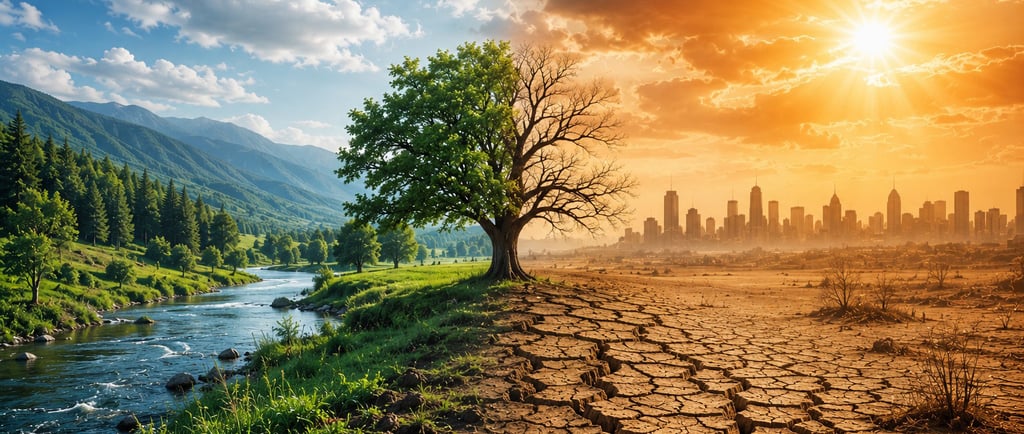
Around the world, prolonged droughts, declining soil moisture and increasing desertification are transforming landscapes. As soils become drier, they absorb more heat and release higher temperatures back into the atmosphere.
This creates a feedback loop that can intensify heatwaves and further accelerate land degradation.
Understanding the relationship between water and temperature may become one of the greatest challenges of the 21st century.
The Hidden Role of Soil Moisture
Water stored in soils plays a fundamental role in regulating surface temperatures.
When soils contain sufficient moisture, part of the Sun’s energy is used for evaporation and plant transpiration rather than heating the ground.
This natural process, known as evapotranspiration, helps cool the land surface and contributes to local and regional climate regulation.
However, when soils become dry, this cooling mechanism weakens.
More solar energy is converted directly into sensible heat, increasing ground temperatures and making heatwaves more intense.
Healthy soils are therefore not only important for agriculture.
They are also part of Earth's natural climate regulation system.
Heat, Humidity and the Water Cycle
Climate is shaped by continuous interactions between land, water and the atmosphere.
As temperatures rise, evaporation increases.
Atmospheric humidity changes.
Rainfall patterns shift.
Vegetation responds.
Each element influences the others.
This interconnected system demonstrates that water is not simply a resource.
It is an active regulator of climate.
The concept of wet-bulb temperature illustrates how heat and atmospheric moisture together determine human heat stress.
Similarly, soil moisture influences how much heat is stored or dissipated across entire landscapes.
Restoring Water to the Landscape
Many climate adaptation strategies focus on infrastructure.
Yet restoring water to ecosystems may also become increasingly important.
Examples include:
wetland restoration
river rehabilitation
groundwater recharge
sustainable irrigation
reforestation
soil conservation
These actions improve water retention and help ecosystems become more resilient to prolonged drought.
Water management is therefore closely connected to climate adaptation.
Could Marine Aquifers Play a Future Role?
An emerging area of scientific interest concerns marine aquifers—freshwater reserves located beneath many coastal seabeds.
These groundwater systems already exist beneath continental shelves around the world.
Although many questions remain regarding their distribution, sustainability and environmental protection, they represent an area deserving further research.
One possible hypothesis is that, if managed responsibly and supported by sound scientific evidence, some freshwater resources could contribute to future landscape restoration projects in water-stressed coastal regions.
Such an approach would require careful environmental assessment, technological innovation and long-term sustainability.
At present, this should be regarded as a research question rather than an established solution.
Water as Climate Infrastructure
Traditionally, infrastructure has referred to roads, dams, pipelines and power plants.
In the future, water itself may increasingly be recognised as climate infrastructure.
Healthy rivers, functioning aquifers, wetlands, forests and moisture-rich soils provide essential ecosystem services that help regulate temperatures and support biodiversity.
Protecting these natural systems may become just as important as building new engineering projects.
A New Perspective for the Water Era
Climate adaptation may not depend solely on reducing emissions.
It may also depend on improving the way societies manage freshwater across landscapes.
Understanding the relationship between soil moisture, evaporation, vegetation and atmospheric processes opens new perspectives for scientific research.
Rather than viewing water only as a resource for consumption, we may begin to see it as one of the planet's most effective natural climate regulators.
Conclusion
The future of climate resilience may depend not only on energy transitions and technological innovation.
It may also depend on how successfully humanity restores and manages the natural water cycle.
Whether through healthier soils, restored ecosystems or future advances in freshwater management, water could become one of the most powerful tools for adapting to a warmer world.
In the emerging Water Era, one question deserves increasing attention:
Can managing water more intelligently help cool the planet?
Pere Castells Teulats
Researcher · Science Communicator