
Europe Is Already in a Water Crisis: The Problem That Could Reshape the Continent
Europe is already facing a water crisis. Drought, scarcity, and pressure on water resources are beginning to affect the economy, energy, and long-term stability of the continent.
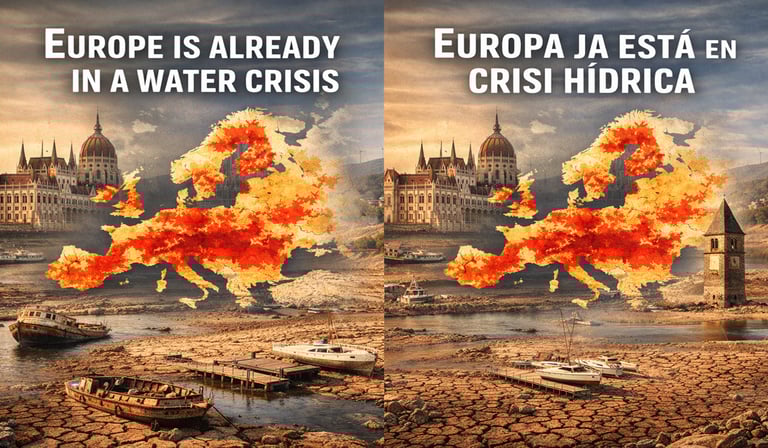
Europe is no longer moving toward a future water crisis.
It is already living through one.
For years, water scarcity was often framed as a distant problem, something affecting other regions of the world more directly than Europe. The continent was generally seen as relatively secure in terms of water availability, with large river systems, reservoirs, aquifers, and developed infrastructure supporting agriculture, cities, and industry.
That perception is changing.
In recent years, Europe has experienced repeated periods of extreme heat, reduced rainfall, depleted reservoirs, falling river levels, and growing restrictions on water use. What was once treated as an exceptional event is becoming a recurring signal of a deeper structural problem.
This is not only about drought.
It is about the growing fragility of the systems that depend on water.
A visible crisis with invisible consequences
The most visible signs of the crisis are easy to identify. Rivers reach unusually low levels. Reservoirs decline. Dry landscapes spread across regions that were once considered stable. Agriculture faces increasing uncertainty. In some areas, water restrictions begin to affect households and economic activity.
But the less visible consequences may be even more important.
Water is not only a natural resource. It is a hidden foundation of modern societies.
It supports food production, industrial activity, energy generation, transport systems, and urban stability. When water availability becomes uncertain, the effects move far beyond the environment. They begin to affect the functioning of the entire economy.
This is why Europe’s water crisis should not be interpreted as a purely climatic issue.
It is a strategic issue.
Beyond climate: a structural imbalance
Climate change is clearly intensifying the situation. Rising temperatures increase evaporation, alter rainfall patterns, and make droughts more frequent and more severe. But the problem cannot be explained by climate alone.
The deeper issue is structural.
For decades, economic development has been built on the assumption that water would remain sufficiently available and manageable. Cities expanded. Agricultural production intensified. Industries grew. Energy systems evolved. Yet all of this depended on a resource whose long-term stability is now under pressure.
At the same time, demand continues to rise.
Urban consumption grows. Irrigation systems require large volumes of water. Industrial processes depend on stable supply. Energy production often relies on cooling systems and water flows. Aquifers are exploited more intensively. And in many regions, available resources are no longer keeping pace with demand.
The result is not simply drought.
It is a structural imbalance between the way Europe uses water and the reality of the resource.
Economic impact is already underway
When water becomes scarce, economic consequences appear quickly.
Agriculture is usually the first sector to feel the pressure. Lower water availability affects crop yields, increases uncertainty, and raises production costs. But the impact does not stop there.
Industrial facilities that require stable water supply may face operational pressure. River transport can become less efficient when water levels are too low for normal navigation. Hydropower production may decline. Cooling systems in thermal or nuclear plants may face constraints. Local shortages can become broader supply-chain problems.
In a continent as interconnected as Europe, these effects are rarely isolated.
A reduction in water availability in one region can influence prices, transport flows, food supply, and industrial output elsewhere. This is what turns a regional drought into a continental strategic challenge.
Water and energy: a critical interdependence
One of the most important aspects of Europe’s water crisis is the relationship between water and energy.
Energy systems depend on water. Water systems often depend on energy.
Hydropower requires water flows. Thermal and nuclear power plants frequently rely on water for cooling. Industry depends on both. At the same time, treatment, pumping, transport, and desalination systems require energy to operate.
This creates a fragile loop.
When water levels fall, energy systems can become less efficient or more vulnerable. When energy becomes unstable or expensive, water systems also come under pressure.
The old idea that water is simply an environmental issue is no longer sufficient. Water is part of critical infrastructure.
And that makes it strategic.
The real issue is management
Not every territory facing lower water availability enters into crisis. Some systems are better prepared than others.
The difference often lies in management.
Where water planning is based on real data, prior verification, efficient allocation, and long-term criteria, systems tend to be more resilient. Where decisions are reactive, fragmented, or driven by assumptions rather than evidence, vulnerability grows.
This is why Europe’s water crisis is not only a problem of scarcity.
It is also a problem of decision-making.
Infrastructure alone is not enough. Building more reservoirs, pipelines, or treatment systems does not solve the issue if the underlying planning remains weak. The key question is not only how much is built, but on what basis decisions are made.
When water becomes strategic, the order of action matters.
Verification before execution. Planning before expansion. Knowledge before investment.
A continental signal of a global shift
What is happening in Europe is part of a larger transformation.
Water is becoming one of the defining strategic factors of the 21st century. During the last century, the global debate about resources revolved around oil, energy, and industrial power. Today, another reality is emerging: no society can function without water security.
Europe is now beginning to experience the limits of a model that long assumed water stability.
That experience matters because it changes the political meaning of water. It is no longer only a technical matter for utilities, engineers, or environmental agencies. It becomes a matter of economic security, territorial stability, and strategic planning.
Conclusion
Europe’s water crisis is not a passing episode.
It is a warning already unfolding in real time.
The challenge is not only to respond to drought, but to rethink how water is understood, verified, managed, and prioritized. In a century shaped by pressure on essential resources, water can no longer be treated as secondary.
The real dividing line will not be between those who have more water and those who have less.
It will be between those who know how to manage it and those who do not.
The problem is not only the lack of water.
It is the way we decide to use it.
Pere Castells Teulats
Researcher-Communicator