
Shared aquifers: the invisible water conflict shaping the future
Shared aquifers are a critical source of freshwater. Their management will shape conflict, cooperation, and global stability in the 21st century.
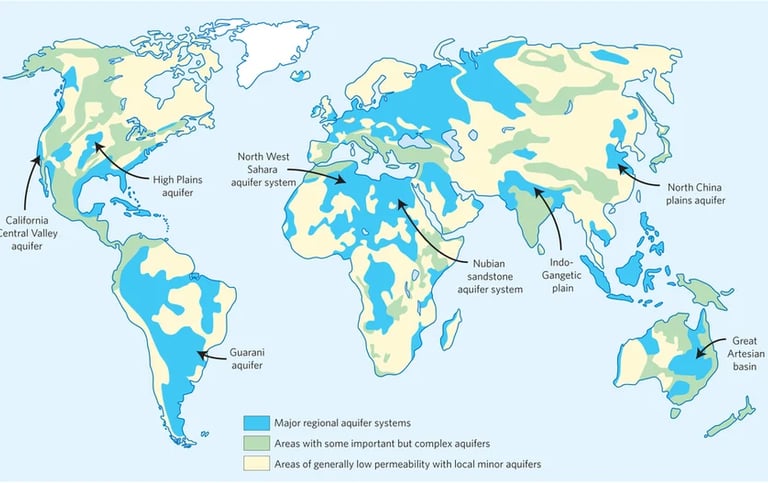
Shared Aquifers: The Invisible Conflict of Groundwater
The water we do not see
When discussing water resources, most people think of rivers, lakes, or reservoirs. However, a very significant portion of the planet’s freshwater is found underground.
Aquifers are geological formations capable of storing large amounts of groundwater. In many parts of the world, they represent the main source of water for cities, agriculture, and industry.
In fact, it is estimated that nearly half of the drinking water used by humanity comes from underground aquifers.
This resource, however, has a characteristic that makes it a potential source of international tension: many aquifers do not belong to a single country.
They extend beneath multiple territories at the same time.
A shared resource beneath borders
Unlike rivers, whose existence is visible and relatively easy to manage through international agreements, underground aquifers remain hidden beneath the surface.
This has meant that for a long time their management has not been a priority in international policy.
However, as water demand increases and surface resources become scarcer, aquifers are gaining strategic importance.
Today, more than 600 transboundary aquifers are known worldwide.
This means that different countries depend on the same underground resource, whose exploitation can affect them all.
The problem of overexploitation
One of the main challenges associated with aquifers is the difficulty of accurately assessing their regeneration capacity.
Groundwater is recharged slowly through natural processes such as rainfall infiltration or seepage from rivers and lakes.
When extraction exceeds the recharge rate, the aquifer level begins to decline.
This can lead to several problems:
gradual depletion of the resource
water salinization
ecosystem degradation
land subsidence
In some cases, the recovery of an aquifer can take decades or even centuries.
Key examples
There are several shared aquifers of major strategic importance.
One of the most well-known is the Guarani Aquifer, located in South America and shared by Brazil, Argentina, Paraguay, and Uruguay. It is one of the largest freshwater reservoirs on the planet.
Another relevant example is the Sahara Aquifer System, which extends beneath several countries in North Africa.
There are also shared aquifers between the United States and Mexico, as well as in various regions of Europe and Asia.
In all these cases, managing the resource requires cooperation between countries.
The geopolitical dimension
The existence of transboundary aquifers raises a fundamental question: who has the right to use this resource, and under what conditions?
When one country extracts large amounts of water from a shared aquifer, it can affect water availability in neighboring territories.
This makes aquifers a potential source of geopolitical tension.
Without adequate cooperation mechanisms, competition for these resources could intensify as pressure on water increases.
Water security and international cooperation
In this context, it is increasingly important to develop international cooperation frameworks that allow aquifers to be managed sustainably.
Water security depends not only on water availability but also on the ability of societies to manage this resource responsibly.
This involves:
improving scientific knowledge of aquifers
establishing agreements between countries
developing monitoring systems
planning long-term water use
A key resource for the future
Global population growth and increasing agricultural demand are putting more pressure on water resources.
In this context, groundwater aquifers may become a crucial strategic reserve.
However, their management requires caution and knowledge.
Unlike other resources, groundwater is difficult to assess and may take a long time to recover if mismanaged.
For this reason, understanding how aquifers function and planning their use responsibly will be one of the major challenges of the 21st century.
The invisible water of the 21st century
The debate about future resources cannot be limited to energy or fossil fuels alone.
It is becoming increasingly clear that water—especially groundwater—will play a fundamental role in the balance of many regions of the world.
Shared aquifers are one of the clearest examples of how water can become a strategic resource.
A resource that, although invisible, can profoundly influence global economic and political stability.
And for this reason, its management lies at the heart of what many analysts are beginning to call the Water Era.
Pere Castells Teulats
Researcher-Dissemination