
The Global Water Crisis Is Not Coming. It Is Already Here
The global water crisis is no longer a future threat. Discover how water scarcity is already reshaping economies, societies, and global stability.
The future has already arrived
For years, the global water crisis has been described as a future problem.
A risk.
A projection.
A warning.
But that framing is no longer accurate.
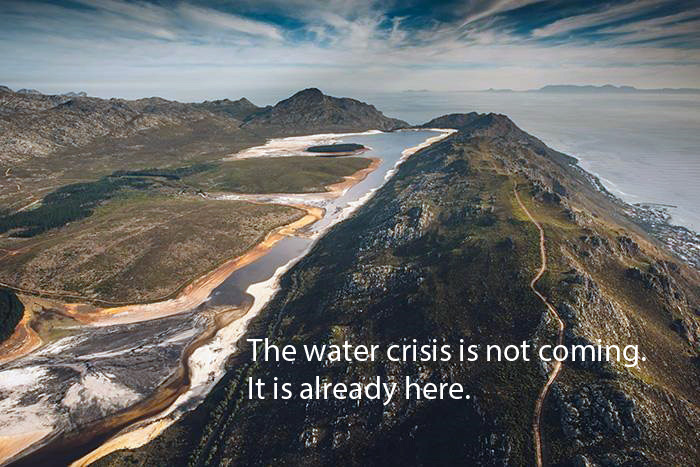
The water crisis is not coming.
It is already here.
Across multiple regions of the world, water scarcity is no longer an exception. It is becoming a structural condition.
A growing imbalance
At the heart of the crisis lies a simple imbalance:
Demand is increasing.
Supply is becoming uncertain.
Population growth, urban expansion, industrial activity, and agricultural demand are placing unprecedented pressure on water resources.
At the same time, climate variability is altering rainfall patterns, increasing drought frequency, and reducing predictability.
This combination creates a system under stress.
The illusion of abundance
For decades, many regions operated under the assumption that water was abundant.
Infrastructure, agriculture, and cities were designed with that belief in mind.
But that assumption is now being challenged.
Reservoirs are reaching lower levels.
Rivers are becoming less predictable.
Aquifers are being depleted faster than they can recharge.
The illusion of abundance is fading.
When water affects everything
Water is not an isolated resource.
It is connected to every major system.
When water becomes scarce, multiple sectors are affected simultaneously:
agriculture and food production
energy generation
industrial processes
urban supply
This interconnectedness turns water scarcity into a systemic risk.
A silent global pattern
The water crisis does not manifest in the same way everywhere.
In some regions, it appears as prolonged drought.
In others, as overexploitation of groundwater.
Elsewhere, as infrastructure limitations or uneven distribution.
Different forms, same underlying issue:
Pressure on a finite resource.
Cities under pressure
Urban areas are particularly vulnerable.
As cities grow, their demand for water increases.
At the same time, their supply often depends on distant sources.
This creates fragile systems.
When supply is disrupted, the impact is immediate.
Agriculture and food security
Agriculture is the largest consumer of freshwater globally.
Without reliable water supply, food production becomes unstable.
This introduces risks not only at a local level, but also globally.
Food prices, supply chains, and economic stability can all be affected.
Water as a strategic resource
As pressure increases, water is gaining strategic importance.
It is no longer only an environmental concern.
It is a factor in economic planning, political decisions, and international relations.
Access to water influences stability.
Control over water influences power.
The role of management
The crisis is not only about scarcity.
It is also about how water is managed.
In some cases, poor planning, inefficient use, and lack of data amplify the problem.
In others, effective management can mitigate risks.
This highlights a critical point:
Water crises are often the result of both natural limits and human decisions.
A turning point
The current situation represents a turning point.
The way societies manage water will define their resilience.
This requires a shift in perspective.
Water can no longer be treated as an unlimited resource.
It must be understood, measured, and managed with precision.
The Water Era
We are entering what many describe as the Water Era.
An era in which water becomes one of the most important factors shaping the future.
Not only environmentally, but economically and geopolitically.
Conclusion
The global water crisis is not a distant scenario.
It is a present reality.
The challenge is not only to respond to it.
It is to understand it.
Because in a world of increasing pressure, the difference will not be made by those who ignore the problem.
It will be made by those who anticipate it.
Final reflection
Water is not only a resource.
It is a condition for stability, development, and life.
Its importance goes beyond visibility.
It defines systems.
Final statement
The crisis of the future is not approaching.
It is already shaping the present.
Pere Castells Teulats
Researcher and Science Communicator