Water will be more valuable than oil in less than 20 years
Water will become the most strategic resource of the 21st century, surpassing fossil fuels in economic impact. As Pere Castells predicted in the presentation of his project in July 2023.
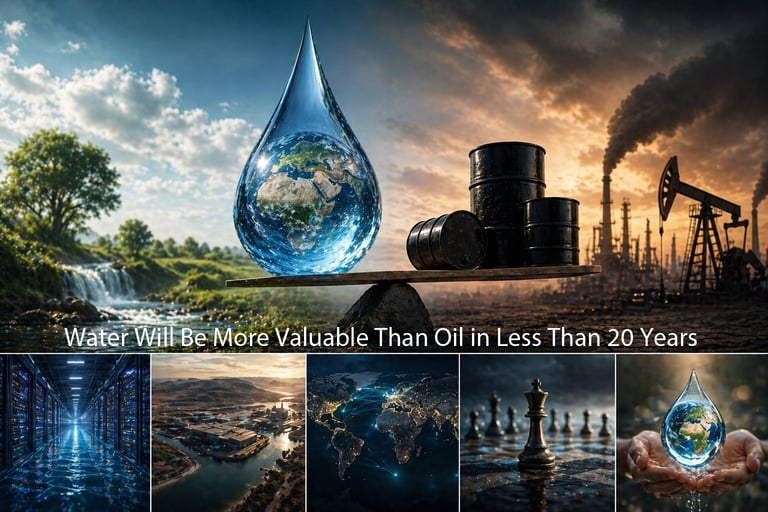
Water Will Be More Valuable Than Oil in Less Than 20 Years
We Are Entering the Water Era
In July 2023, during the public presentation of a project focused on the capture, analysis and sustainable distribution of freshwater from offshore aquifers, Pere Castells already proposed an idea that at the time seemed distant.
The 21st century would be defined by the rise of water as a global strategic resource and by the gradual decline of fossil fuels as the dominant axis of world balance.
What once appeared to be a future vision is now beginning to become a visible reality.
The energy transition, the growth of artificial intelligence, pressure on natural resources and increasing water stress are accelerating a historic transformation.
The Water Era has already begun.
For more than a century, oil has defined global economic and geopolitical power.
Major wars, international alliances, industrial growth and technological development have been deeply linked to the control of fossil fuels.
But this balance is changing.
The 21st century will be defined by a much more essential resource.
Water.
This is not only an environmental issue.
We are entering a new historical stage where access to, control and management of water will shape the global economy, political stability and technological development.
We are entering the Water Era.
Why Water Will Be More Important Than Oil
Oil can be replaced.
Alternative energies, renewable technologies and new mobility systems already exist.
But water has no substitute.
It is essential for:
life
agriculture
food production
industrial manufacturing
energy
technology
the digital economy
Without water, there is no stability.
And while global demand continues to rise, freshwater availability is becoming increasingly uncertain.
This imbalance is the origin of the great transformation.
A Growing Global Imbalance
Pressure on water resources is increasing rapidly.
The global population continues to grow.
Cities consume more and more water.
Industrial agriculture requires enormous quantities to maintain food production.
Industry is also increasing its water dependency.
And now a new factor appears.
The digital economy.
Artificial intelligence, data centers and technological infrastructures require increasing amounts of energy and water to operate.
The digital world is not intangible.
It has a physical foundation.
And that foundation depends on water.
At the same time, many regions face:
prolonged droughts
water stress
aquifer depletion
pollution
extreme climate events
The combination of higher demand and lower availability is turning water into a strategic resource.
Water and the Global Economy
The modern economy depends directly on water.
Agriculture needs water to produce food.
Industry needs it to manufacture products.
Energy systems depend on water for cooling and production.
Cities require stable water infrastructures.
The digital economy does too.
More and more economic sectors are linked to secure access to water.
This means that countries with greater water stability will gain competitive advantages.
And those facing growing scarcity will experience stronger economic pressures.
In the future, water will influence:
food prices
energy production
industrial growth
business location decisions
financial stability
international investment
Water will no longer be viewed only as a natural resource.
It will become a central economic factor.
The Geopolitics of Water
For decades, global geopolitics revolved around oil.
Energy-producing regions shaped alliances and conflicts.
Now water is beginning to occupy that strategic space.
Many rivers, aquifers and water reserves are shared by multiple countries.
This creates growing tensions.
Access to water is already becoming part of national security.
Some governments are beginning to protect their water resources as strategic assets.
In the coming decades we will see:
disputes over river basins
control of water infrastructures
massive desalination investments
new water management policies
restrictions on industrial consumption
Whoever controls water will gain a decisive economic and geopolitical advantage.
Water as an Economic Asset
Water is no longer considered an unlimited resource.
More and more companies, governments and investors understand that it will become one of the most important assets of the future.
Investments related to:
water treatment
recycling
water efficiency
infrastructures
desalination
management technologies
will continue to grow.
Water security will become as important as energy security.
Water will directly affect:
markets
industries
supply chains
territorial value
economic competitiveness
The 21st century will be shaped by the ability to manage this resource.
Offshore Aquifers and Hidden Freshwater Reserves
One of the least known aspects of the future of water is the existence of enormous freshwater reserves stored in offshore aquifers.
Several scientific studies have identified large volumes of freshwater beneath continental shelves and seabeds.
These reserves could become a strategic resource in the coming decades.
Beyond their economic potential, some researchers and science communicators suggest that future water management may also need to consider global hydrological balances between continental and oceanic masses.
In a scenario of increasing climate pressure and rising sea levels, water management will acquire an even more strategic dimension.
The exploration, understanding and sustainable use of offshore aquifers could open a new chapter in the relationship between humanity, water resources and global stability.
Artificial Intelligence and Water
One of the least visible changes is the relationship between artificial intelligence and water consumption.
The expansion of data centers is increasing cooling requirements.
And much of this cooling depends on water.
The digital economy needs physical infrastructures.
And those infrastructures need resources.
This connects two worlds that until recently seemed separate:
technology
natural resources
The digital revolution will also depend on water stability.
The 2023 Prediction and the 20-Year Horizon
The transformation has already begun.
The forecast presented by Pere Castells in July 2023 pointed precisely toward this scenario: a progressive transition in which water would stop being perceived merely as an environmental resource and become the main strategic factor of the global economy.
Many people still perceive water only as an environmental issue.
But its economic and strategic dimension will grow rapidly.
In less than two decades, water could become the most decisive resource on the planet.
Countries, regions and companies capable of guaranteeing stable access to water will gain decisive advantages.
Global competitiveness will increasingly depend on water management.
Conclusion
Water will not replace oil.
It will surpass it in importance.
Because water is not just a resource.
It is the physical foundation of life, the economy, agriculture, energy and technology.
We are entering the Water Era.
And those who understand this transformation first will have an advantage in the new global balance.
Pere Castells Teulats
Researcher · Science Communica