
From water (H2O) to liquid hydrogen (LH2): the energy of the aerospace future
Liquid hydrogen (LH2) is emerging as one of the strategic fuels of the aerospace future. Its relationship with hydrogen (H), molecular hydrogen (H2), space propulsion and the energy transition is opening a new technological era.
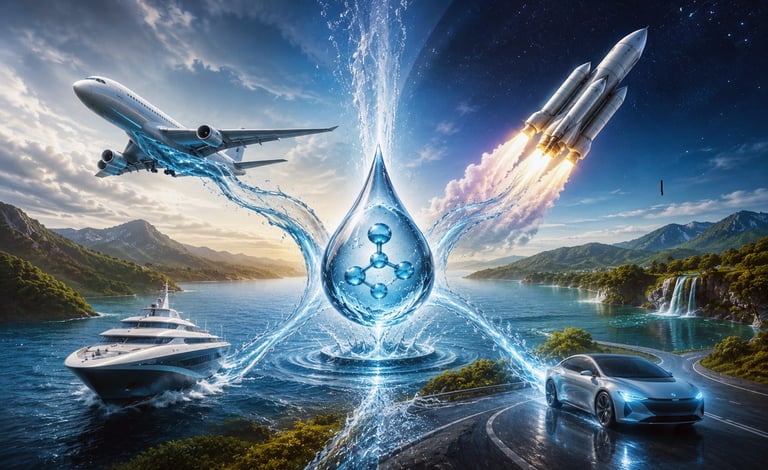
The Role of Liquid Hydrogen (LH2) in the Aerospace Industry
From Water (H2O) to Hydrogen (H)
Water (H2O) is one of the most important molecules for life and for the balance of the planet.
It is composed of two hydrogen atoms and one oxygen atom.
Although it is usually perceived only as a water resource, water also represents an enormous potential reserve of hydrogen.
Through electrolysis processes, water can be separated into hydrogen (H2) and oxygen.
This process is becoming increasingly important within the global energy transition.
The combination of water, renewable electricity and hydrogen could transform multiple industrial and technological sectors.
In this context, water ceases to be only an environmental resource.
It also becomes a potential strategic source of energy.
Hydrogen (H): The Fundamental Element of the Universe
Hydrogen, chemically represented as H, is the most abundant element in the universe.
It is considered the first great building block of visible matter.
Stars, including the Sun, generate much of their energy through fusion processes related to hydrogen.
From a cosmological perspective, much of the known universe is dominated by this extremely light and energetic element.
Hydrogen occupies the first position in the periodic table.
It contains a single proton and one electron, giving it unique physical and chemical properties.
Despite its structural simplicity, hydrogen participates in some of the most important energy processes in the cosmos.
Hydrogen is also directly linked to the origin of life.
Water (H2O), the basis of all known biological systems, contains hydrogen as one of its essential components.
From Hydrogen (H) to Molecular Hydrogen (H2)
Molecular hydrogen (H2) represents the most stable and usable form of hydrogen in many industrial and energy applications.
When two hydrogen atoms combine, they form H2, an extremely light gas with very high energy capacity per unit of mass.
These properties have made hydrogen one of the most studied fuels for advanced technological applications.
What Is Liquid Hydrogen (LH2)
Liquid hydrogen, known as LH2, is obtained by cooling molecular hydrogen to approximately -253 °C.
In this cryogenic state, hydrogen occupies much less volume than in gaseous form, allowing it to be stored and used as a highly efficient fuel.
LH2 possesses unique characteristics:
very high specific energy
low molecular weight
clean combustion
high propulsion capability
These properties make it especially attractive for the aerospace industry.
Hydrogen and Space Exploration
The space industry has used liquid hydrogen for decades.
Many major launch systems have employed combinations of LH2 and liquid oxygen (LOX) in their upper stages.
The reason is simple.
Hydrogen provides one of the highest specific impulses among known chemical fuels.
This allows:
increased launch efficiency
reduced structural mass
improved orbital performance
facilitation of long-distance missions
Historic programs such as NASA’s Space Shuttle used LH2 as a fundamental component of their propulsion systems.
Today, several agencies and private companies continue to study its use in future generations of spacecraft.
LH2 and the New Space Economy
The new space race is accelerating interest in advanced energy technologies.
The growth of:
satellites
space tourism
lunar missions
Mars exploration
orbital platforms
will increase the need for more efficient propulsion systems.
In this context, LH2 appears as one of the strongest candidates.
In addition to rockets, hydrogen could also play an important role in:
space power generation systems
fuel cells
orbital energy storage
future lunar infrastructures
Strategic Advantages of LH2
Liquid hydrogen presents major advantages for the aerospace future.
1. High Energy Efficiency
Its high energy-to-weight ratio makes it one of the most efficient chemical fuels.
2. Emission Reduction
Hydrogen combustion mainly produces water vapor.
This makes it a potentially cleaner alternative compared to fossil fuels.
3. Integration with Renewable Energy
Hydrogen can be produced through electrolysis using renewable electricity.
This opens the possibility of more sustainable energy systems.
4. Potential for Advanced Aviation
Some projects are studying the use of liquid hydrogen in next-generation aircraft.
Long-range aviation could become one of the major development fields for LH2.
The Major Challenges of Liquid Hydrogen
Despite its enormous potential, LH2 also presents significant technological challenges.
Cryogenic Storage
Maintaining hydrogen at extremely low temperatures requires complex and expensive systems.
Low Volumetric Density
Although it has high energy per mass, it occupies much more volume than other fuels.
Limited Infrastructure
Hydrogen production, transport and storage still require major investments.
Safety and Handling
Hydrogen is highly flammable and requires advanced safety protocols.
Hydrogen, Energy and the Technological Future
The development of LH2 does not depend only on the space industry.
It is part of a broader energy transition.
Many governments and companies consider hydrogen one of the key technologies of the 21st century.
Its applications could extend to:
heavy industry
maritime transport
aviation
energy storage
electricity generation
space exploration
The aerospace industry could become one of the major innovation drivers around hydrogen.
The Connection Between Water and Hydrogen
There is also a fundamental relationship between water and hydrogen.
Hydrogen can be obtained from water through electrolysis.
This directly connects:
water resources
energy
sustainability
aerospace industry
In the future, the availability of water and renewable energy could influence the ability to produce hydrogen on a large scale.
Conclusion
Liquid hydrogen (LH2) represents much more than a space fuel.
It is emerging as one of the strategic technologies of the future energy and aerospace sectors.
Its high efficiency, potential integration with renewable energy and ability to power new generations of space systems make it a key element of the global technological transition.
From water (H2O) to hydrogen (H), from H to molecular hydrogen (H2), and from H2 to liquid hydrogen (LH2), humanity continues exploring new forms of energy to expand its technological limits.
Pere Castells Teulats
Researcher · Science Communicator