
Marine Aquifers: The Hidden Freshwater Reserves Beneath the Sea
Hidden beneath coastal seas, marine aquifers contain vast freshwater reserves. Learn why these little-known resources could play a key role in future water security and global water management.
Marine Aquifers: The Hidden Freshwater Reserves Beneath the Sea
An Existing Resource Hidden in Plain Sight
When people think about freshwater resources, they usually imagine rivers, lakes, glaciers or underground aquifers located on land.
For decades, these sources have been considered the foundations of water security for human societies.
However, beneath many coastal regions around the world lies a little-known resource that could significantly change our understanding of global freshwater availability: marine aquifers.
Unlike futuristic concepts or hypothetical discoveries, marine aquifers already exist.
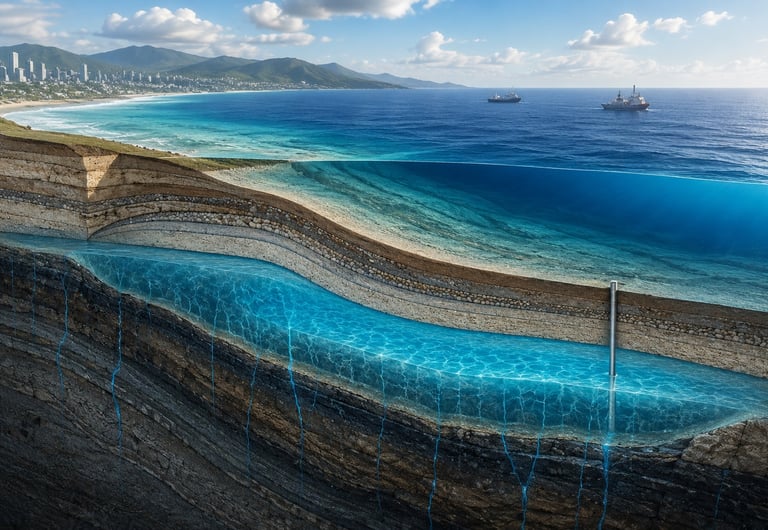
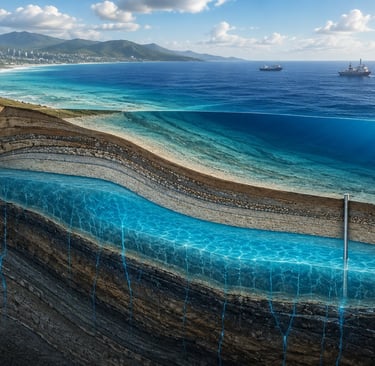
They are real geological formations containing freshwater trapped beneath the seafloor, often extending from continental aquifers that were formed thousands of years ago when sea levels were lower than they are today.
Although largely unknown to the general public, marine aquifers may represent one of the most significant freshwater resources on Earth.
What Are Marine Aquifers?
Marine aquifers are underground geological formations located beneath the seabed that contain freshwater or low-salinity groundwater.
Many of these reserves were created during past geological periods when large areas of the continental shelf were exposed above sea level.
Rainwater infiltrated the soil and accumulated within porous rock formations and sediment layers.
As sea levels rose after the last Ice Age, many of these freshwater reserves remained trapped beneath the ocean floor.
Today, they continue to exist beneath coastal waters around the world.
These hidden reservoirs can be found beneath continental shelves, often extending many kilometers offshore.
In some cases, they contain enormous volumes of groundwater that have remained relatively isolated for thousands of years.
Scientific Evidence Beneath the Oceans
For many years, marine aquifers received limited scientific attention.
However, advances in marine geophysics, offshore drilling and electromagnetic surveying have significantly improved our understanding of these hidden resources.
Research conducted in different parts of the world has identified large offshore freshwater systems beneath continental margins.
Marine aquifers have been detected near:
Australia
New Zealand
Southeast Asia
South Africa
Europe
North America
Scientific studies suggest that substantial volumes of groundwater may exist beneath many coastal regions.
Although the exact size of global marine aquifer reserves remains uncertain, their existence is no longer questioned by the scientific community.
The challenge now is understanding their distribution, characteristics and potential role in future water management strategies.
Why Marine Aquifers Matter Today
The importance of marine aquifers is not primarily a future issue.
It is a present-day issue.
Many regions of the world are already experiencing increasing water stress caused by:
population growth
urban expansion
industrial development
climate change
prolonged droughts
Freshwater demand continues to rise while many traditional water sources face growing pressure.
In this context, marine aquifers represent an existing resource that deserves greater scientific and strategic attention.
Their potential significance lies not only in the volume of water they may contain, but also in their geographical location.
Many of the world's largest cities are located along coastlines, precisely where marine aquifers are most likely to occur.
Water Security and Strategic Planning
Throughout history, access to water has influenced economic development, agricultural productivity and social stability.
Today, water security is becoming increasingly connected to national security.
Governments are investing heavily in water infrastructure, desalination plants, reservoirs and groundwater management systems.
Yet marine aquifers remain largely absent from public discussions.
This does not mean they are unimportant.
On the contrary, understanding offshore groundwater systems may become increasingly relevant as countries seek to diversify their water resources.
Marine aquifers should not necessarily be viewed as immediate replacements for existing water supplies.
Instead, they may become part of a broader strategy aimed at strengthening long-term water resilience.
Geopolitical Implications
Water has traditionally been treated as an environmental or local resource.
However, the growing global water crisis is giving water a new geopolitical dimension.
Countries increasingly compete for secure access to energy, food and critical resources.
Water is becoming part of that equation.
Marine aquifers introduce new questions regarding:
resource management
offshore rights
environmental protection
strategic planning
As knowledge about these resources expands, governments may need to establish legal and regulatory frameworks to address their potential use.
The existence of freshwater beneath coastal waters may eventually become a factor in regional water strategies and international cooperation.
Environmental Considerations
Any discussion about marine aquifers must also consider environmental sustainability.
These groundwater systems are often poorly understood.
Excessive extraction could potentially alter groundwater balances, affect coastal ecosystems or increase saltwater intrusion.
For this reason, scientific research must remain at the center of any future development strategy.
The objective should not be exploitation at any cost.
Rather, it should be understanding, protecting and managing these resources responsibly.
Sustainable management will be essential if marine aquifers are to contribute positively to future water security.
The Water Era Beneath the Sea
The growing interest in marine aquifers reflects a broader transformation already taking place around the world.
Water is no longer viewed solely as a natural resource.
It is increasingly recognized as strategic infrastructure that supports economic development, technological growth and social stability.
For decades, global discussions focused primarily on energy resources.
Today, water is emerging as one of the defining strategic assets of the 21st century.
Marine aquifers illustrate how much remains to be discovered about the planet’s freshwater systems.
Some of the most important water resources may not lie in remote mountains, rivers or reservoirs.
They may already exist beneath the sea.
Conclusion
Marine aquifers are not a future possibility.
They are an existing reality.
Hidden beneath continental shelves and coastal waters, these freshwater reserves challenge traditional assumptions about where freshwater can be found.
Although many scientific, technical and environmental questions remain unanswered, marine aquifers deserve greater attention from researchers, policymakers and society as a whole.
In a century increasingly shaped by water security, understanding the resources that already exist may be just as important as discovering new ones.
The Water Era may not begin with the search for new freshwater sources.
It may begin with recognizing the value of the freshwater resources that have been hidden beneath the sea all along.
Pere Castells Teulats
Researcher · Science Communicator
Shared aquifers: the invisible water conflict shaping the future