
The Panama Canal and the Global Water Crisis
The Panama Canal reveals how water scarcity and drought can impact global trade, logistics and economic stability in the emerging Water Era.
The Panama Canal and the Global Water Crisis
When Drought Affects Global Trade
For more than a century, the Panama Canal has been one of the clearest symbols of globalization.
This maritime corridor connects the Atlantic and Pacific Oceans, allowing thousands of ships to avoid the long route around South America.
Thanks to this infrastructure, international trade operates with greater speed and efficiency.
Every year, thousands of vessels cross the canal transporting goods, energy and raw materials between continents.
However, in recent years the Panama Canal has begun to reveal a growing global vulnerability: dependence on water.
A Canal Dependent on Freshwater
Contrary to what many people imagine, the Panama Canal does not function simply as a natural passage between two oceans.
Its operation depends on a complex lock system that raises and lowers ships as they cross the Panamanian isthmus.
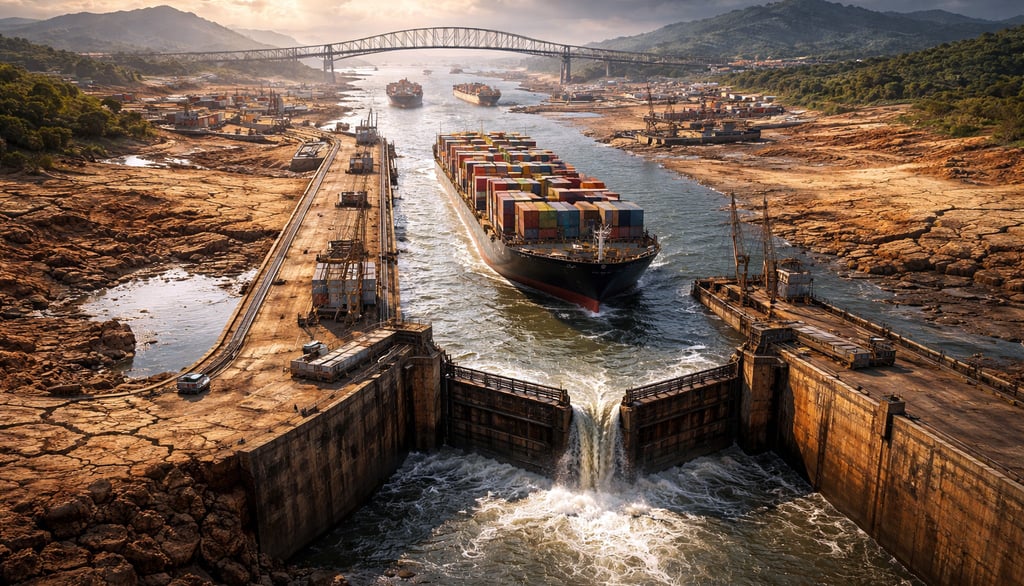
Every time a vessel passes through the canal, enormous quantities of freshwater are released from the artificial lakes feeding the system.
The most important of these lakes is Gatún Lake, which acts as a strategic water reserve for canal operations.
Each transit can require millions of liters of freshwater.
This means that the canal depends directly on the hydrological balance of the region.
The Impact of Drought
In recent years, Panama has experienced increasingly intense drought periods.
Reduced rainfall has caused water levels in the lakes supplying the canal to decline significantly.
When this occurs, the Panama Canal Authority is forced to limit the number of ships allowed to cross the waterway each day.
This situation has major consequences for international trade.
Fewer ships mean delays in maritime transport, rising logistics costs and growing pressure on alternative commercial routes.
A Global Chain Reaction
The Panama Canal is not merely a regional infrastructure.
It is one of the key arteries of global trade.
A significant share of the goods circulating between Asia, the Americas and Europe passes through this route every year.
When canal traffic is reduced, the impact can spread rapidly across multiple sectors:
maritime transport
international trade
commodity prices
global supply chains
In a highly interconnected world, disruptions at strategic points can generate economic chain reactions on a global scale.
Water as Invisible Infrastructure
The Panama Canal illustrates a reality that often goes unnoticed.
Many of the modern world’s critical infrastructures depend directly on water.
Energy production, agriculture, industry, transportation and digital infrastructure all require stable water resources.
When water becomes scarce, even highly developed systems can be affected.
For this reason, water is increasingly being considered a strategic factor in long-term economic planning.
The Strategic Dimension of Water
For decades, debates surrounding strategic resources focused mainly on oil and energy.
Today, another factor capable of reshaping the global economy is emerging: water availability.
The Panama Canal is a clear example of how water can become a critical element in the functioning of international trade.
The drought affecting the canal demonstrates that even some of the world’s most advanced infrastructures may depend on something as fundamental as freshwater.
Adaptation and Resource Management
In response to these challenges, Panamanian authorities are studying different strategies to guarantee the canal’s long-term operation.
These include:
improving water management systems
developing additional water reserves
optimizing lock efficiency
adapting infrastructure to more variable climate conditions
The objective is to ensure that the canal can continue operating in a context of climate change and growing hydrological instability.
The Panama Canal in the Water Era
The Panama Canal demonstrates that water is acquiring increasing strategic importance in the 21st century.
What for decades was considered an abundant and guaranteed resource is progressively becoming a critical factor for essential infrastructures.
In an increasingly interconnected world, water availability can directly influence trade, energy and economic stability.
Understanding the role of water in global systems may become essential for anticipating future economic and geopolitical challenges.
The Panama Canal is only one example of a much broader transformation already underway.
The 21st century will not be shaped only by energy or technology.
It may also be defined by how societies manage one of their most essential strategic resources: water.
The global water crisis is not coming.
It is already here.
Pere Castells Teulats
Researcher · Science Communicator