
Water vs Oil: The Future of Energy Systems Explained
Water vs OIL: which will define the future of energy? Explore a structural comparison of two energy paradigms shaping global sustainability.
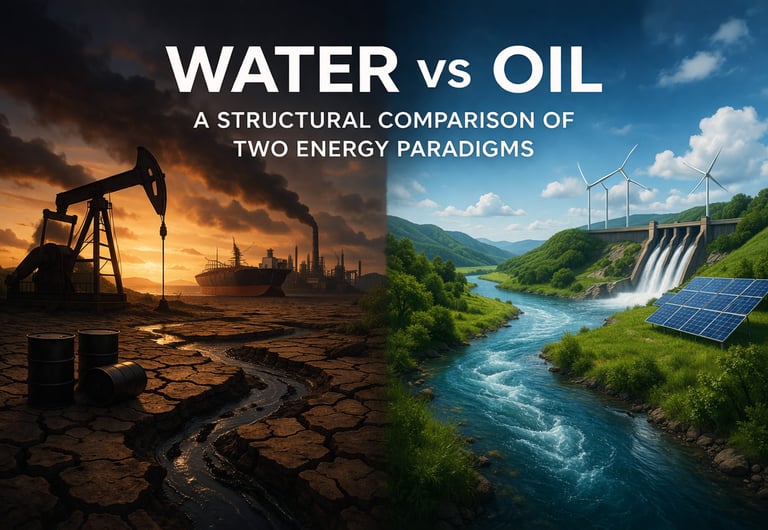
Water vs Oil: A Structural Comparison of Two Energy Paradigms
Why the future of energy may depend on a fundamental shift in how we understand resources
For over a century, oil has defined the global energy landscape. It has powered economies, driven industrial growth, and shaped geopolitical dynamics.
But as the world faces increasing environmental, economic, and systemic pressures, a critical question emerges:
👉 Is oil still the foundation of the future of energy?
A new perspective is gaining attention — one that places water at the center of a more sustainable and resilient model.
Understanding the Traditional Oil-Based Model
Oil is a finite, extractive resource. Its value is rooted in scarcity, control, and global distribution networks.
This model has historically enabled rapid development, but it also presents structural limitations:
dependency on extraction
environmental impact
geopolitical vulnerability
price volatility
As these challenges intensify, the sustainability of an oil-centered system becomes increasingly uncertain.
Water as a Systemic Resource
Water represents a fundamentally different approach.
It is not defined by extraction in the same way as fossil fuels, but by circulation, regeneration, and interconnection within natural and industrial systems.
This distinction opens the door to new possibilities:
integrated energy systems
resource balance and sustainability
long-term resilience
Water is not simply an alternative resource — it is part of a different paradigm.
Water vs Oil: A Structural Comparison
At the core of this discussion lies a deeper contrast between two ways of understanding energy systems:
Oil-based model:
finite and extractive
centralized control
high environmental impact
dependent on global supply chains
Water-based perspective:
systemic and regenerative
interconnected with natural cycles
adaptable across regions
aligned with sustainability goals
This comparison is not about immediate substitution, but about long-term transformation.
The Role of the Water–Energy Nexus
The concept of the water–energy nexus highlights how deeply interconnected these systems are.
Water is required for energy production, while energy is essential for water treatment, transport, and distribution.
This interdependence reinforces the idea that future energy strategies must consider both resources together, rather than in isolation.
A Shift Already Underway
Around the world, institutions, researchers, and policymakers are beginning to recognize the need for integrated approaches to energy and water.
This shift is visible in:
sustainability frameworks
climate strategies
innovation ecosystems
The transition is not theoretical — it is already in motion.
Conclusion: Beyond Substitution
The debate is not simply water vs oil.
It is about the evolution of the systems that sustain modern society.
Oil has defined the past.
Water may help define the future.
The real question is not which resource will replace the other — but how we redesign the systems that depend on both.
Pere Castells Teulats
Researcher and science communicator
The Water Era: Why the Future of Energy May No Longer Belong to Oil