The Nile Water Conflict
A Key Example of Geopolitics in the 21st Century
A Real-World Example of Strategic Conflict in the 21st Century
The Nile water conflict is one of the clearest examples of water geopolitics in the 21st century.
For decades, discussions about conflicts over natural resources have focused on oil, gas, and strategic minerals. However, a different factor is now emerging as a powerful force capable of shaping the stability of entire regions: water.
The Nile River illustrates how access to and control of water resources can acquire a geopolitical dimension.
At over 6,600 kilometers in length, the Nile is one of the longest rivers on the planet and flows through or directly influences several African countries. For millions of people, it is an essential source of water for drinking, agriculture, and energy production.
However, it is also a shared resource — and this is precisely what makes it strategically sensitive.
A Vital River for Egypt
For Egypt, the Nile is not just an important river. It is the foundation of its existence as a country.
More than 90% of Egypt’s population lives along the river and depends on its waters for agriculture, urban supply, and economic development.
In a territory largely dominated by desert, the Nile has sustained Egyptian civilization for millennia.
For this reason, any significant change in the river’s flow is perceived as a matter of national security.
The Role of Ethiopia
For many years, Egypt and Sudan were the countries that most controlled the use of the Nile’s waters.
However, in recent decades, Ethiopia has begun developing large hydroelectric projects on the Blue Nile, one of the river’s main tributaries.
The most important of these is the Grand Ethiopian Renaissance Dam (GERD), one of the largest hydroelectric infrastructure projects in Africa.
For Ethiopia, the dam represents a historic opportunity to:
produce energy
boost economic development
improve living conditions
For Egypt, however, the situation is viewed very differently.
A Delicate Balance
Egypt fears that filling and managing the dam’s reservoir could reduce the flow of water into its territory.
A significant decrease could affect:
agriculture
urban water supply
economic stability
This explains why negotiations between Egypt, Ethiopia, and Sudan have been long and complex.
The challenge lies in finding a balance that allows Ethiopia to harness the river’s hydroelectric potential without jeopardizing the water security of downstream countries.
The Nile as an Example of Water Geopolitics
The Nile case clearly illustrates a phenomenon that is increasingly visible around the world.
When multiple countries depend on the same water resource, water management ceases to be merely a technical or environmental issue.
It becomes a geopolitical one.
Decisions about dams, irrigation systems, or hydraulic infrastructure can influence food security, economic growth, and the social stability of entire regions.
For this reason, international cooperation is essential to prevent competition for water from escalating into conflict.
This case is part of a broader global trend of water conflicts, as explored in When Water Becomes More Valuable Than Oil.
A Growing Challenge in the 21st Century
The Nile is not an isolated case.
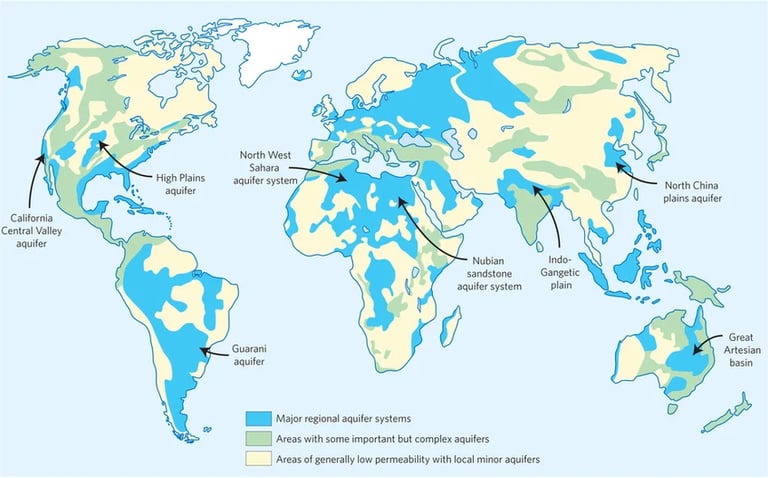
In many regions of the world, shared rivers and aquifers require joint management mechanisms.
Similar situations can be found in:
the Indus River in Asia
the Tigris and Euphrates in the Middle East
the Mekong in Southeast Asia
In all these cases, water is a vital resource whose management requires cooperation between states.
As pressure on water resources increases, these shared systems may become critical points in the global balance.
The Importance of Water Security
In this context, the concept of water security is becoming increasingly relevant.
Ensuring sustainable access to water is essential for:
social stability
food production
economic activity
Effective water management requires information, planning, and cooperation.
Understanding water systems, assessing their real availability, and making informed decisions are key to avoiding future tensions.
The Nile and the Water Era
The case of the Nile shows clearly that water is gaining strategic importance.
For decades, global discussions focused on energy and fossil fuels.
Today, a new reality is emerging.
The stability of many regions may increasingly depend on how water resources are managed.
Understanding the geopolitics of water is therefore essential to anticipating future challenges.
Because, as is becoming increasingly clear, the 21st century is entering a new phase:
The Water Era
Final Reflection
Oil shaped the past.
Water will shape the future.
Pere Castells Teulats
Researcher – Science Communicator