
Water vs Oil: The Strategic Resource That Will Define the 21st Century
Water vs oil: discover why water is becoming the key strategic resource of the 21st century and how it will reshape global economy and geopolitics.
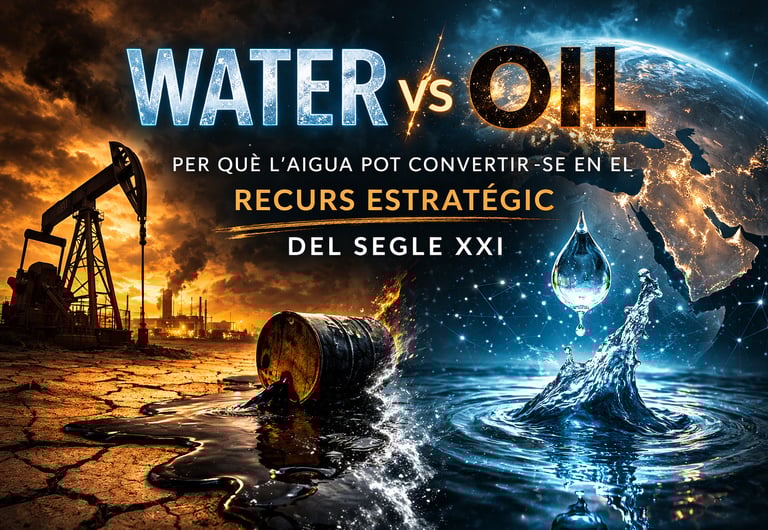
Water vs Oil: The Resource That Will Define the 21st Century
If oil were blocked today, the world would face an energy crisis.
If water were blocked tomorrow, the world would face a vital crisis.
Water security is becoming one of the major strategic challenges of the 21st century.
For more than a century, global power has revolved around oil. Wars, alliances, embargoes, and military strategies have been shaped by energy control. But as the energy transition advances, another resource is emerging as a determining factor: water.
Not as an environmental symbol.
As a strategic resource.
The question is no longer whether water will be key.
The question is whether we are prepared to manage it as the central resource of the 21st century.
From the Oil Era to the Water Era
The 20th century was defined by oil geopolitics. Control over wells, pipelines, and maritime routes shaped the global economy and the balance of power.
The 21st century presents a different scenario:
sustained population growth
accelerated urbanization
increasing climate pressure
overexploitation of aquifers
contamination of water resources
Unlike oil, water has no technological substitute. There is no viable alternative to potable water for human, agricultural, and industrial use.
When oil becomes scarce, energy prices rise.
When water becomes scarce, life itself is put under pressure.
This difference is structural.
Water as a Global Security Factor
Water security is now a common term in international forums. The global water crisis is no longer a future prediction, but an ongoing reality.
Regions facing severe water stress depend on:
intensive desalination
deep aquifers
long-distance water transport systems
highly energy-dependent infrastructures
The interdependence between energy and water is increasingly evident. Without stable energy, complex water systems cannot operate effectively.
This makes water a strategic resource with direct geopolitical implications.
When Water “Becomes” More Valuable Than Oil
Saying that water may be more valuable than oil is not a market statement. It is a structural one.
Oil is an energy resource.
Water is a vital resource.
A country can reduce its energy dependence through renewables.
It cannot reduce its dependence on water.
When water becomes scarce:
external dependency increases
shared basins become sources of tension
social risks intensify
agricultural systems destabilize
International rivers and transboundary aquifers can become axes of conflict without solid cooperation.
This is not alarmism. It is an observable dynamic.
The Challenge Is Not Only Scarcity, but Management
Not all regions facing scarcity fall into crisis. The difference often lies not in the quantity of water, but in the quality of its management.
When water planning is based on prior technical verification:
water capture is based on real data
infrastructure adapts to available resources
structural risk is reduced
system resilience increases
When decisions are based on assumptions rather than verification, systems become fragile.
In an era where water is gaining strategic importance, improvisation is no longer acceptable.
Infrastructure and Structural Order
Public debate often focuses on building more: more dams, more desalination plants, more pipelines.
But the essential question comes first:
On what data are decisions made?
When is the resource verified?
What structural criteria guide investment?
The difference between a resilient system and a vulnerable one is not just the volume of investment, but the order of the process.
When execution depends on objective technical verification, risk decreases. When it does not, risk multiplies.
The Water Era Is Already Here
There will be no official day marking the end of the oil era. The transition is gradual, but profound.
Every time:
a city imposes restrictions
a shared basin generates diplomatic tension
an aquifer degrades
a water infrastructure fails due to lack of verification
it confirms that water is becoming central to global balance.
The question is not whether water will define the 21st century.
The question is whether we will manage it structurally or reactively.
Conclusion
The oil era defined the power of the 20th century.
The water era will define the stability of the 21st century.
In this new scenario, the difference will not be made by those who build more, but by those who manage better.
And when a resource is both vital and strategic, the margin for error disappears.
The debate about water security is no longer regional. It is global.
Pere Castells Teulats
Researcher-Communicator